If you’re in a relationship, having a work spouse is cheating
Is labeling or fantasizing a coworker as a work spouse (work wife or work husband) considered being unfaithful, and is there more behind the title?
When you’re in a relationship or married, having a work spouse is cheating. And there’s no changing my mind on this one. Leave this glamorized and, nowadays, normalized workplace trend to the single folk.
Hey – have we forgotten that emotional affairs are a thing?
I know I’m about to trigger the steam from people’s ears, but this one gets me so fired UP! When we’re talking about marriage, why are we downplaying THE most honest commitment two people can *promise* to one another?
I don’t care if it’s all for laughs, or if you say it’s not that *deep*. There’s too much emphasis on the insignificance of this trend while I believe it only serves to emphasize the lack of respect for marriage.
I’m aware – there are those who will cherry pick and claim that I am trying to say, “You can’t have work friends and/or work relations with those of the opposite sex!”
That’s not what I’m saying here. In fact, I do my very best to point out the differences between a “colleague” and its perversion, the “work spouse”, and why one can be considered a detriment to the integrity of a committed relationship. So hang tight.

30+ Examples of cheating (that don’t start in the bedroom)
Notice how people who cheat tend to find some way to deflect responsibility, justify their action, come up with excuses, have their reasoning(s) or ultimately blame their partner for something they acted on? Many truly believe they have not been unfaithful simply because genitals never touched.
What we unpack in this post..
As I am nose-deep in researching this trend, I stumbled across article after article that PERPETUATES the dynamic among couples – “claiming studies showing this *level* of workplace relations – outside a relationship – are beneficial to mental health“.
Cool, cool, cool, yup, improving our mental health…at the expense of the integrity for our spouse, and the respect they rightfully deserve.
How can these *experts* (yes, psychologists) defend such hypocrisy when a work spouse, work husband or work wife literally promotes and embodies emotional infidelity?
So I went ahead and dissected this work-relationship from my perspective as a married woman. Among individuals who are in a committed relationship, this needs to be quickly laid to rest because this is a serious slap of disrespect to your real spouse’s face.
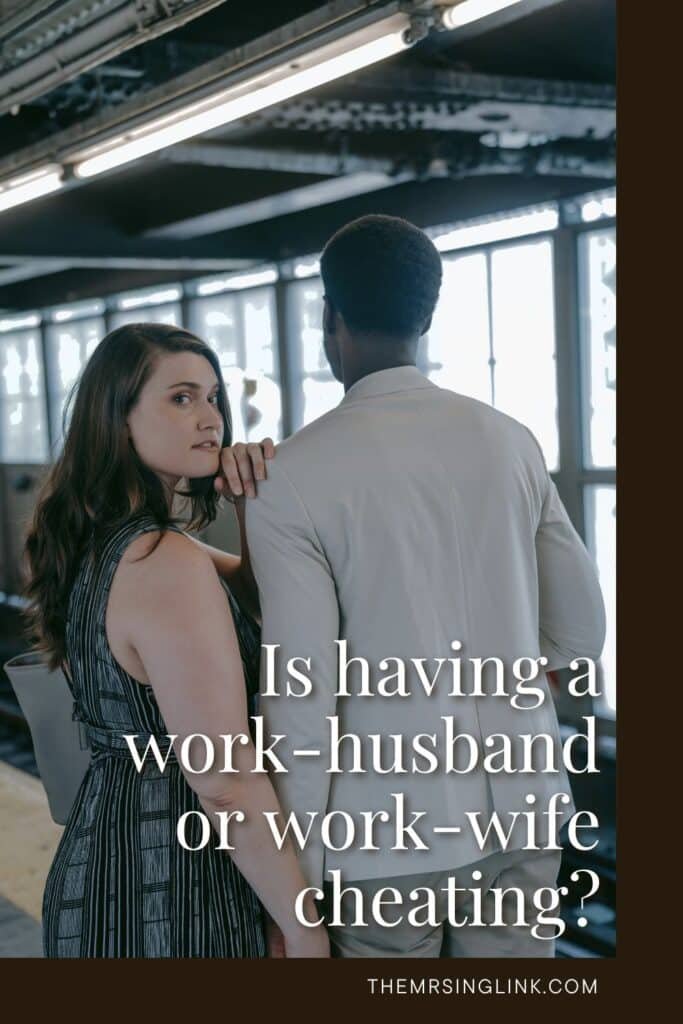
“Work spouse” is a fancy, boundless label with indirect and implicit meaning
The label itself completely disregards and disrespects your real spouse – period. The worst part is those, without even questioning it, are willing to jeopardize the quality of their real relationship over it. As if having a work spouse is oh-so dire – an entitlement, even – for your overall happiness, esteem, and work productivity. Please.
Whether you find the meaning behind it appropriate, acceptable, or *not a big deal* is telling. Having to use the label of a “work spouse” is covering the truth with a lie (calling bad good). It’s a conspicuous and dancing-around-the-bush way of saying,
-“…It’s okay to keep my personal life and work life [relations] completely separate (aka, secret).” **So, essentially having a double life while you’re in a relationship.
-“…I’m [sexually] attracted to you, but since I’m already in a relationship, I’ll just keep you as close as I can without crossing that line.” **Meanwhile, your real spouse remains clueless of your blatant intent to continually lust over this work spouse behind their back.
-“…you fill in the gaps of my real relationship (aka, you provide me what my relationship can’t/doesn’t).” **Then this would mean everyone in a relationship needs a “buffer” or “filler”, which perpetuates the opposite of being content with (accepting) what we already have because our culture pushes having more or better (perfection).
“…using this label makes it *okay* because I’m drawing a line somewhere in the sand..” **Therefore, weaponizing your “freedoms” by moving the bar between right and wrong as you see fit.
For as long as you establish that label in defense of certain inappropriate behaviors with your work spouse, this desensitizes the significance of what constitutes as a committed, monogamous relationship and what classifies as unfaithfulness.
Oh, hello again, emotional infidelity!
If you can’t see where I’m headed by now, you don’t need to get physical or be attracted to someone for it to be considered a multi-relationship (aka, an emotional affair). In case you need reminding, cheating on your partner starts with you, not in the bedroom.
*Just FYI, if you and your partner identify as being polyamorous, then obviously there’s no point in you even reading this post.

“There are things I can only share with my work spouse”
Like what, exactly? You’re certainly not spending hours endlessly talking about your shared passion for pickleball while your real spouse despises it.
Sure, maybe your real spouse wants nothing to do with politics, and your so-called “work spouse” shares your similar views. This bonds you. That’s dandy – doesn’t mean they suddenly deserve special treatment or access to you that your spouse doesn’t, and it certainly doesn’t make them worthy of a special title that sets them apart from (but like an extension of) your real spouse.
This level of distinguished comparison is where it all begins and manifests slowly, giving you enough leverage to call it “just friends” without an iota of conviction. In fact, you see absolutely nothing wrong with this type of connection when I see this as a connection compensating for your real spouse.
The real problem is when you are more open about your real relationship with your work spouse than you are your work-relationship with your real spouse. Inconspicuously, this follows with your work spouse becoming the default person you share things with and confide in while the opposite occurs with your real spouse.
The idea that we are to have external connections apart from our spouse is one thing, but the encouragement to seek out emotional consolation and comfort (attention and affection) from someone else is another.
The lines then become blurred between privacy and secrecy as well as of what goes on in your work spouse relationship.

6 Crucial things a decade of marriage has taught me
I’m sharing my personal experience and insight of being married for 10 years, and some of the unfiltered realities marriage has taught me after a decade. My goal is for this to be a suitable read for both men and women, husbands and wives, since marriage will always consist of two parties coming together in a unified process and ongoing learning experience.
It’s ride or die with your work spouse but your real spouse is simply “too much”
To make things easier, from now on let’s use WS (work spouse) and RS (real spouse). It’s already super annoying to have to add the word real to spouse just to make a point.
Here’s where I’m going with this one: somehow, since it is a work-relationship, you’re more likely to swiftly come to their aid, be at their defense, listen to them spew, rant, vent or emotionally dump, give them anything they need, be whoever and wherever for them, go out of your way to deliver and impress while being at their disposal…then normalize and justify the nature of this dynamic as platonic while identifying them as your WS.
But this very same behavior with your RS, and their needs, is somehow classified as “too much”; too demanding, too dependent, too inconvenient, too exhausting, too needy, too clingy. Now they’re treated as the “jealous”, overbearing spouse where their needs and feelings become a “chore” or obligation.
I’d argue it’s simply the thrill (excitement) of your WS not being your RS, and the bonus of receiving a paycheck.
Still, make it make sense. Why would the person you made no promise [commitment] to get served the larger platter, let alone served first (aka, receiving the best of you), as well as receive a title for it that only your RS deserves (and earned through commitment)?
All I’m saying is, if my husband were prioritizing work-relationship quality, security, fulfillment, and stability with someone – man or woman -that is beyond the threshold of work ethic, work-place professionalism and productivity over his wife and marriage, and to deem it not only his desire but duty, then he is no longer choosing to be married. *And that’s putting it nicely.
All goes without saying that work spouse qualities do not equate to a professional work-relationship.

Calling someone a work wife or work husband means you’ve already established unfair comparisons
As in between your WS and your RS. You have already established what your WS can give and is willing to provide you versus what your RS cannot, isn’t and/or won’t. When this happens,
- You can start giving your WS your very best (of your time, energy, and effort) while your RS ends up receiving the breadcrumbs or bottom of the barrel, and they’ll usually be the one to blame.
- You may decide your RS is no longer this or that (i.e., dependable, assertive, caring [toward the relationship]) merely because your WS has proven to be more those things in and out of the workplace.
- You may begin to see your RS incapable of fulfilling your [relationship] needs simply because your WS is currently fulfilling those things, or more.
- You get the sense that you and your RS are not as compatible (or “in love”) as you think simply because you and your WS are capable of spending the entire day working together (as a “team”) and being in each other’s presence (and it not get “old”, without combativeness).
- You can end up treating your RS as the inferior, or the person who needs to change (matching the level your WS brings to the table), and then being resentful of your RS when that doesn’t happen (while your WS is merely attuned to your needs in that of a compatible “work” relationship).
- You may dwindle or drop off from feeling the need or desire to engage, connect or communicate with your RS because you receive that from your WS 8+ hours of the day, 5 days a week.
- You might start expecting your RS to read your mind (to fulfill your needs) in hopes they can live up to your WS (who is the current individual you’re capable of, willfully and openly expressing your needs/wants to).
GRANTED, I can recognize that one singular person is NOT capable or expected of meeting each and every one of our needs and expectations. It’s unrealistic whether in a relationship or in other non-romantic connections. That’s why we are obviously encouraged to have connections and support from multiple sources on a platonic level.
The conflict of interest is when these other connections become or act as a replacement or placeholder in a spot that only our RS fills. We need to be able to ask the question(s), “Is this [interaction/behavior] really fair to my RS? Does this [interaction/behavior] respect the entity of marriage and partnership?“

Are opposite sex friendships a threat to marriage?
The thing is, I don’t think the majority are necessarily dying on the hill that says it’s impossible to be friends with the opposite sex, it’s that the dynamic differs from all the others (especially marriage) and that the connection should be treated accordingly and respectfully.
“It’s not cheating, it’s just terminology”
Is it, thouuuugh? Then it’s totally acceptable for your RS to refer to another person by addressing them as beautiful or handsome, “Hey, beautiful/handsome.” That doesn’t mean anything, right, it’s just *terminology*? That words are words, regardless of the way in which they’re used and their value. Are we really going there?
Terms are only words, yes, but we place meaning in our language. Referring to someone as a work wife or work husband is not just nothing, sorry.
If a work-relationship is strictly platonic in nature, then there’s no need for special terminology resembling marriage, is there? Because without it you’re nothing more than colleagues, coworkers or – *gasp* – friends.
Is it JUST a term or is there more behind it?
In droves they will come, those who will claim that I am adding something to nothing and that I am taking the whole label way too seriously. But I will always come back with how strange it is to be that comfortable using such a word, claiming it has no meaning, and thereby implying the term husband, wife and marriage also have no meaning (value).
So if you’re willing to push the envelope for someone over terminology, why isn’t the terminology of wife, husband, spouse, or married at the tippy top of your moral pedestal? I mean no shade, but the person you choose to commit and stay loyal to is actually entitled to that #1 spot.
Your RS earned that rightful title through marriage, which means we are to forsake all others. Your RS is to be elevated above and apart from everyone else. Being given this label of a spouse makes them “special”, honorable, and deserving of something no one else can or should have.
Don’t like that? There’s an easy option – don’t get married.
By offering or willingly placing someone else up on that very same pedestal as your RS, you’re establishing a WS and RS to have a shared or equivalent level of respect, honor and intimacy. Then nothing would be off limits between your spouse and others, therefore infidelity wouldn’t exist.
By giving someone else that title you’re essentially making it known and clear to your RS that they are disposable and replaceable – that their title of “husband”, “wife” or simply “spouse” is not sacred (for one person only) and holds little to no value or special meaning to you.
Part of me wonders WHY I even had to write this post in the first place when it boils down to respect. Respect for your spouse on a separate and higher elevation from anyone else.
If that is somehow triggering, then the issue at heart is very self-focused – honoring your spouse above others, including yourself, is inconceivable if it means not getting to do *whatever it is you want to do* without consequence.
 wpDiscuz