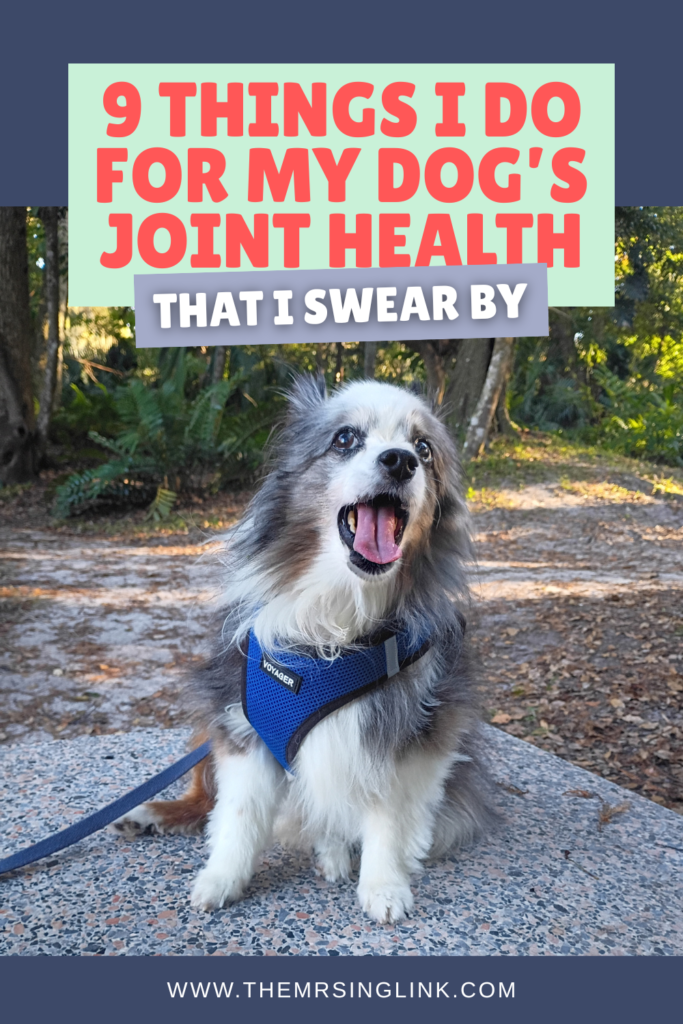
My dog’s joint health matters and being proactive about your dog’s joints starts earlier in their life than you’d expect. These are the things that work for my senior dog’s joint pain and mobility as he ages.
You might be thinking, “This is an extensive list!” and you’re right. The thing is, I’ve learned over time what works for my dog’s joint health, what works better alongside other things, which things are a no-brainer must, as well as rotating some of the things on this list as my senior dog ages.
Our dog’s joint health should come as no surprise in the pet parent world, since we’re likely told by vets fairly early on that it’s something we need to consider, being that our beloved canine’s lifetime is just a blip compared to our own.
Truly, we don’t think we have to think about it until we do, right? And oftentimes it’s a little too late. And even I wish I had started sooner.
Maybe this is your nudge to start before potential problems begin with your dog’s joints, or you’re already in the realm of senior doghood and are in need of as many recommendations as you can find. Hopefully I can offer some things you haven’t heard of or been told before.
My old man is 14 and 1/2, by the way. He started really showing muscular, nerve and arthritic issues around 8-9 years old, and that’s when my real journey began trying to figure out what works best for him, his mobility and joint discomfort.
So why do I rotate, you ask? The way I see it is our bodies can be accustomed to using the same thing over and over, which may result in decrease of effectiveness. Even too much of one thing can end up being harsh on the body. But don’t take my word for it – it’s just something I do.
Also, on certain things, like supplements, sometimes products change their ingredients, the quality of the ingredients or ingredient amounts, which may land me in a position to switch up what my dog is receiving at the time. And I’m a pretty proactive dog mom that likes to have a Plan B and even C on hand.
You might be surprised not to see certain things on this list, like specific injections or acupuncture. As I stated, this post pertains to the things I have been and am currently doing for my dog’s joints, what has worked and continues to work when he is experiencing joint pain. I have tried acupuncture in the past but didn’t seem to notice a solid improvement or steady change.
Plus, it’s one of those things that carry a hefty price tag (I was quoted over $400 for 4-6 weeks of acupuncture) when you’re expected to commit to weeks of treatment and, oftentimes, ongoing.
But what works for my senior dog’s joints may not for another, and vice versa. I am simply here to provide possible benefit and relief based on what’s currently working for my dog.
Right – the list! Let’s get to it since, duh, that’s why you’re here.
I’m always looking for more recommendations or ideas, so if you have any please feel free to share in a comment!
9 Things I swear by for my senior dog’s joints
This post contains affiliate links. All products and links listed on TML are affiliates through 3rd parties such as Awin, Etsy and Amazon. Meaning, at no cost to you, by clicking and purchasing through those links I will earn a small commission. As an Amazon Associate, I earn from qualifying purchases. To learn more read TML Terms and Disclosure.
As always, it’s recommended that you discuss with your veterinarian about your dog’s joint health first.
Weight management
Please, don’t skip just yet, hear me out. Back when my dog was at his 8-year mark, I never actually considered whether he needed to lose weight, despite being told by my vet he was a “chunker” and could afford to lose a few. I just didn’t take it seriously, TBH, when I was trying to manage his other health issues at the time.
There was a point where he got to 21 pounds around 5-6 years old – as a small breed toy Australian shepherd and papillon mix – when he should land around the 15–17-pound range. You wouldn’t think that extra 4-6 pounds means much, but for a dog his size…a pound is pretty significant, and especially if he’s gaining or losing it fairly quickly.
Plus, as he got older, the more significance managing his weight would have on his health when he was diagnosed with Mitral Valve Disease (of the heart).
So I started really focusing on his weight more as he approached his double digits. Or tried my best, at least. Then, when he was 12, he was suspected to having hypothyroidism, but my vet suggested him to lose more weight and see if the numbers improved. And so I managed to bring my boy’s weight down from around 17-18 pounds to 15-16 pounds.
The following year, his T-3 numbers still weren’t up to par, so it was recommended he be on thyroid medication.
Anyway, there’s really a point to this. Over the course of 4-ish years of taking his weight more seriously, I noticed that managing my dog’s weight did help improve certain ailments he would often experience off and on in his late adult and early senior years. From random limping, slight acute injuries due to running, jumping, playing or certain movements (i.e., climbing up stairs) and even sluggishness when getting up from a laying or sitting position.
Him losing weight simply benefitted his will and ability to be more active, getting around and moving, which still does have a positive effect on mobility. So let this be your reminder that even “a few pounds” can be the thing that ignites or steers your dog’s joint health in a better direction.
If you aren’t sure if your dog is a proper weight or could benefit from shedding a couple pounds, talk to your vet.
The right supplements
You know, like Glucosamine, MSM (Methylsulfonylmethane), Chondroitin Sulfate, Green Lipped Muscle and even Omegas, magnesium, green tea, Boswellia and Hyaluronic Acid. Now it’s not always easy to find a supplement that has it all, and your dog may not need them all.
That’s why it is important to discuss these with your vet first. As someone who has one foot in conventionally and the other in alternatively, I balance the advice between both my conventional and holistic/alternative veterinarians.
Variations of this supplement combo can be found in the popular products such as Cosequin and Dasuquin. These products are usually the known standard when it comes to our dog’s joints and are the most likely to be recommended by your DVMs.
I’m not doggin’ them – no pun intended – because I used those products religiously back when my dog first started having mobility issues and joint pain.
Did they help? Seemingly, for a time. I guess, at this point, these things alone simply aren’t going to cut it for him, though it’s not that these supplements are hurtful in any way. That being said, I won’t not recommend them, but there are many similar products out there now. You do have to be careful which ones you choose.
I prefer to look for the NASC seal, at the very least, since they aim to set the standard for quality, potency and efficacy.
For a while my boy took a hiatus on this supplement combo after being on it for a few years. I last had him on Wholistic Pet Organics Joint Mobility GLM, and they also have just a joint supplement without the multivitamin called Run Free.
I also ventured into giving him Green Lipped Muscle, which is known for its anti-inflammatory properties and fairly quick relief of joint discomfort. I can attest that when I started giving my dog GLM, it wasn’t long before I noticed he seemed more…loosey-goosey and less stiff.
He’s been alternating between Four Leave Rover Hip & Joint and Super Snouts Green Lipped Muscle (both NASC certified) for a few years now and I can see it has helped him greatly to the point I can start giving this intermittently (or as needed) and interchangeably with a Glucosamine, MSM and Chondroitin combo.
Next, I will be trying the Wuffles Advanced Joint Liquid. I can’t attest to its efficacy as of yet, but it does have the NASC seal and it contains Boswellia (an anti-inflammatory herbal supplement), which is already a plus in my book.
Hydrotherapy
No, I’m serious. I realize this can be tough for those without a pool or access to one that allows dogs, but if you can find somewhere that does (or can afford regular hydrotherapy sessions), this can be some of the best treatment and exercise for stiff, aching joints and muscles.
I do this as often as I can for my senior boy, knowing it probably isn’t helpful to bathe him more than once or twice a week, but just 10 minutes doing guided doggy paddle in our pool has not only kept him in shape but the anti-gravity effects of floating in water has done wonders for his joints.
And if your dog isn’t the greatest swimmer or needs extra help to stay afloat so they don’t ingest water, don’t skimp on having them wear a life vest. Just get one, anyway – safety first.

Collagen
Yes, the efficacy controversy. In old age collagen is reduced, which is necessary to help lubricate the joints and tendons, so in my mind this supplement is something that works alongside the others, like MSM to help reduce inflammation. Collagen was actually one of the number of things recommended by my vet to try a handful of years back now.
After doing a ton of research, the consensus was to look for hydrolyzed collagen, which is insanely difficult to find (or products that blatantly label their collagen as hydrolyzed) as well as specific types of collagen. Revive Multi Hydrolyzed Collagen has been the product I’ve stayed with since.
It’s not technically for pet use, but I made sure the collagen was unflavored and without any added, unnecessary ingredients as well as researched specifically how much collagen my dog could be given daily and went by that.
Can I say it has helped tremendously? Well, it’s difficult to say when collagen is something that likely takes time to notice sustained improvement.
Since I started implementing collagen, I will say my senior boy has had fewer limping or gimping spells, his slightly torn ACL has not worsened, he has noticeably less nerve discomfort in his neck and back (he’s had fewer spasms – sometimes going a year without one at all), almost never skips due to his double luxating patella, and he does seem to go up and down stairs much easier (with less cracking in his knees).
So I’d call that a win.
Red light laser therapy
This may already be a service offered at your vet because it’s actually been around for a while. Even people are now using red light therapy for its benefits.
But, as always, these routine treatments at the vet can be costly, especially if I wanted my senior dog to have these done often. Basically, for the rest of his life. So I did my own digging to find that the upfront cost to be able to do laser light therapy from home for my dog’s joints is much more cost effective.
Plus, he can have it as often as needed.
Online there are many devices that are specifically designed for human-use, but I decided to go with a device for pet-use. The biggest thing was ensuring I was getting a product worth the investment, since there are so many different products out there and not all of them – excuse my ignorance on the topic and its terms – have the right wattage or irradiance for healing benefits. So there’s a good chance of getting ripped off or buying a cheap product that does absolutely nothing for your dog if you don’t know what to look for.
Anyway, I came across the Helio Pet. For one thing, it was founded and developed by veterinarians, so I knew I could trust that I was getting the real deal, especially for that price tag. It’s the price of just a handful of treatments at the vet, so I was rest assured it was worth the investment. Besides, they had a 30-day money-back guarantee.
My senior dog has been getting treatments with his Helio for years now. I just simply plug it in when it needs to be recharged, and a full charge using the Max setting lasts for well over a week if I use the Helio daily.
There has definitely been improvement in the long run, and depending on what he’s getting it for, oftentimes the effects are immediate (after a full 15-minute treatment). He has awful arthritis in his elbows as well as a slight tear in his ACL, and I can tell that when I use the laser therapy consistently, he seems to experience relief.
Plus, he’s spent most of his life with skin issues and flare ups, and his Helio seems to give him anti-inflammatory relief topically as well.
This is definitely an option I would recommend for anyone with a pet who is healing from surgery or an injury, experiencing arthritis or joint stiffness, and even common ailments such as sore or tight muscles.

Jump for JOYnts
I didn’t sprinkle this one into the supplements category because I felt it deserved its own – it’s honestly *that* good.
I had been using the Adored Beast Apothocary products for years, particularly their probiotics, before hearing about this one. I saw their new Jump for JOYnts in a pamphlet I received from my holistic vet who started promoting carrying their products in-house.
Honestly, it took me months to decide if I wanted to try anything else, or new. My senior dog now being 14 and a half, I didn’t want to overload him to the point where I can’t see what’s working and what’s not, but after a few months I wanted to give it a go because he had been having off and on limping in his front legs due to learning about his severe arthritis in his elbows from recent radiographs.
He just wasn’t getting around or going on as long of walks comfortably due to that.
Even the receptionist said it worked amazing for her dog, so I was very hopeful! Once I purchased it, I started it right away, and I couldn’t believe that within days I saw improvement in just the way he walked and how much more he was willing and able to get around.
There was even a morning he pranced to go outside, and he hadn’t done that in months.
Jump for JOYnts is a homeopathic liquid containing Calendula Officinalis, Ruta Graveolens, Arnica Montana and Symphytum Officinale. You can give orally and even spray it topically. This is great for me because I can use the sprayer top it comes with to actually target the cute little bald spots that have developed on his elbows for extra targeted relief. Or I can simply spray a few pumps into his food using the dripper top.
I’ve been using it for well over a month daily and I’m just half way through the bottle. And at $26 a bottle at my holistic vet or $30 online, this is one – without a doubt – that will ALWAYS be in my senior dog’s Old Man Bag for his joint health.

tPEMF therapy
Remember when I said I like to change things up? Before I started using red light laser therapy for my senior dog’s joints, I first learned about the tPEMF therapy from my vet. tPEMF, or Pulsed Electromagnetic Field Therapy, is basically the process of triggering the animals natural healing ability through electromagnetic waves.
Initially, I was looking for something to help alleviate my dog’s inflammation and discomfort due to nerve/muscle spasms (still not totally sure) in his upper back and neck area. He had been having them off and on since the age of 8 years old, likely due to a previous injury (such as jumping off the couch).
At the time when I heard about this therapy, it was fairly *new*, especially in the pet health realm. And it was expensive.
Outsourcing services for this kind of treatment were next to none, with the exception of learning about the Assisi Loop from my vet. Back nearly 7 years ago now, this was one of the firsts of its kind for tPEMF treatment on animals that you could do from home.
Out of caution, the Assisi company does not recommend use of its product on animals with hemangiosarcoma.
They also have what’s called the Assisi Lounge, which is a plug-in tPEMF bed that comes in different sizes as well. Essentially, the bed is an all-over body PEMF treatment. The beds can cost upwards of $2,000, whereas the Loop costs $329.
Needless to say, after much deliberation on the price, we caved and bought the Assisi Loop because we were desperate to find alternative relief rather than keeping my boy on medications like Gabapentin (which wasn’t doing much for him pain wise besides making him act *weird*, tbh) for the rest of his life.
Granted, the Loop still had a hefty price, and I thought it was crazy to trust that this dinky device was sending out electromagnetic waves to supposedly heal my dog.
The Assisi Loop is essentially a necklace that comes in different sizes depending on the size of your pet, where you place the device on the targeted area for healing. The Loop only contains so many uses once you start the first treatment. You simply press the button and it turns on the 15-minute timer – once the device stops flashing, the 15 minutes are up and your Loop is turned off until you press the button again.
According to the website, the Loop contains approximately 150 15-minute uses, or more if you allow the battery to fully rest between treatments. How often you use the Assissi Loop is how long it will last.
I was super surprised that the Loop had actually lasted over a year and a half, and I definitely feel like I got more than 150 uses!
For the first few weeks, I probably used the device almost twice daily, then scaled it back to once a day for several weeks. Then for a good hunk of its remaining time I was only doing a treatment as needed, up to 3 days a week, or more consecutively if I noticed my dog was experiencing discomfort, had a spasm, or started limping.
For someone who is going to use the device far more than I did, it may last for less time. For others who use it less will likely have it for much longer. Either way, singular treatments cost upwards of $100 per session, so I’d say $300 for the year is definitely getting my money’s worth if it is something that helps my dog’s joint health and even injury recovery.
Okay, so, is it actually effective? At the time when we got the Loop, my dog was on nothing but a simple joint supplement, had started Gabapentin not too long beforehand, and was also prescribed NSAIDS intermittently. So when we started using the Loop it did take some time not only for my dog to get used to the device (having to lay still for 15 minutes) but to notice any improvements.
You’d think because I haven’t purchased it again that it wasn’t helpful, but that simply isn’t true. I actually believe the device helped a lot over time, and I will still swear by it in that I would purchase it again. And that’s why I am still going to include this in my list since there may be a time I do purchase it again if I need to.
CBD + CBDA
Another one that’s fairly controversial, but I. Don’t. Care. I’ve had my senior dog on CBD full-time since he was about 9 or 10 years old. I guess I started for a slew of reasons, from mobility discomfort to stress and anxiety relief.
First of all, CBD and CBDA Hemp oil do not make our animals *high*. More and more studies are slowly coming to fruition that show Full Spectrum CBD Hemp Oil is beneficial for dog’s joint health as well as stress and anxiety, cognitive function, skin and brain health.
CBD has been an overall miracle worker for my aging senior dog’s chronic skin issues (alleviating itchiness and inflammation), keeping his separation anxiety and general anxiety from stress at bay (improving his sleep, and mine) as well as aiding his joint health (improving overall mobility and discomfort from arthritus and inflammation).
And at this point in his life, at 14 and change, I wholeheartedly believe CBD has been a positive contribution to his overall wellbeing on a cognitive level.
At 14, he’s lively, engaged and stimulated. People constantly mistaken him for being a puppy.
That being said, ElleVet CBD + CBDA is another staple product for my dog’s joint health and overall wellbeing that will always be in his Old Man Bag. It was formulated by veterinarians, third party tested, and has undergone clinical trials at Cornell, which means you can trust you are receiving a quality, full spectrum CBD.

At-home massage
This one is severely underrated, mainly because either dog owners feel they don’t have the time, don’t know what to do and where to start, or never considered massage as something that would help their dog’s joint discomfort and mobility.
And it’s absolutely free, with the exception of a little bit of your time.
Granted, you might not see crazy improvement by massage alone, but like with humans…we get massages all the time for muscle tension, sore tendons and stiffness across all areas of our body. So why wouldn’t something like this be beneficial for our pets?
I stressed at-home because I have yet to find commercial services that extend beyond acupuncture and chiropractic care for our pet’s joint health and inflammation. But there are many helpful videos on YouTube to get you started with simply the basics.
I went ahead and did the digging to get you started (here, here and here), or you can simply type in YouTube Search, “Dog Massage for Mobility“.
This post contains affiliate links. All products and links listed on TML are affiliates through 3rd parties such as Awin, Etsy and Amazon. Meaning, at no cost to you, by clicking and purchasing through those links I will earn a small commission. As an Amazon Associate, I earn from qualifying purchases. To learn more read TML Terms and Disclosure.