Can single and married women actually be friends?
Are married women the common denominator for friendship affliction, and are single friends constantly at a disadvantage?
I want to start off by saying – as a married woman (without children) – I can actually understand the argument being made by single friends. The issue being that many single women are feeling exiled by their married friends. For me, I can also attest to feeling outcasted or somehow not *included* – again, as a married woman – by other married women with children.
Is there a level of truth to this? I can believe it. So buckle up, ladies, because it’s a long one!
What we unpack in this post..
On the other hand, what needs to be taken more into account is that friendships after marriage are likely to experience some level of a natural shift. This means, *deep inhale*, I can also understand the argument or counterargument being made by married friends (and those with children).
I’m primarily speaking in response to the video on this article I stumbled upon (I encourage you to listen), where a woman has seemingly gone viral on social media for expressing that married women are more self-centered in friendship. From her shared experience, examples and perspective, it sounds like married women with and without children are included in her argument.
In turn, the basis is that the single friends are being neglected in friendship (or wiped off the totem pole of value and prioritization). And as a married woman (without children), I aim to share my *hopefully* fair and honest perspective from both sides, and to emphasize that friendships between single and married women are not a one-sided issue.

Are married women *actually* more self-centered?
Referring back to the video in that article, the woman openly expresses her belief that married women become very self-centered. For me, personally, her statement is rather generalized – enough for me to counter with that married women are, in fact, the opposite of self-centered.
Let me rephrase that. Marriage is [to be] the embodiment of selflessness, making it the opposite of self-focused. To say that married women are more self-centered is a flawed argument when married women lawfully commit to considering the needs, feelings and best interest of another person – AKA, their spouse, while forsaking all others.
If the claim is that married women are self-centered according to friendship standards, then we can also state the same claim for single friends. It’s rather self-centered of single friends to expect their married friends to measure up in the manner of friendship that of prior to marriage. It’s also self-centered to feel entitled to a person – who they are prior to life events and circumstances – to fit an individual, self-serving mold.
Friendship not revolving around single friends doesn’t somehow make married women self-centered. It’s entirely baseless to claim that only married friends are self-centered in friendship.
Are life-dynamic differences in friendship the breaking point?
Are single and married friends simply butting heads due to drastic differences in life milestones and dynamics?
Here’s a fact that remains unchanged: married women with kids have additional priorities and responsibilities to consider in their immediate family unit, therefore they allocate more time to their spouse and children.
This is what a difference in those dynamics would look like on a scale depicting a single woman and a married woman with kids.
And, no, there’s not a Right or Wrong here.
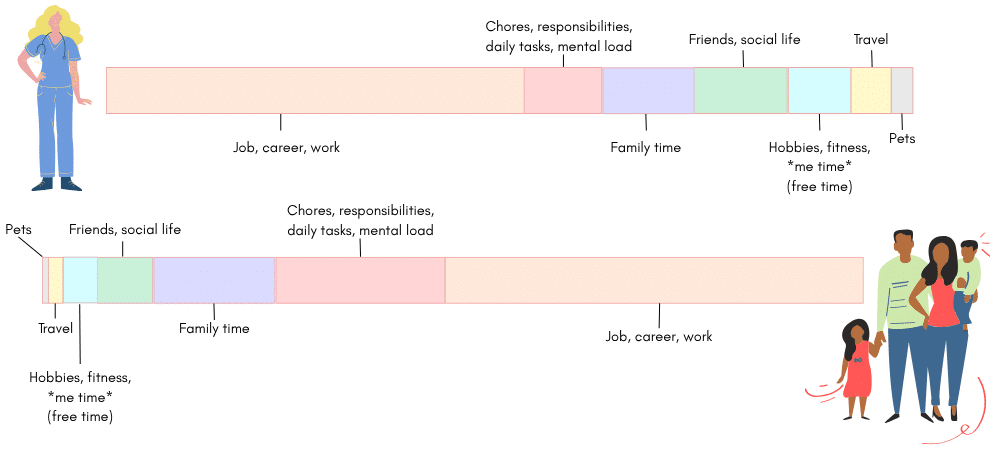
For reference, and to make the depiction fair, both women are working women (so the ‘job, career, work’ sections are the same in size for both), and I also arranged the meter similarly by importance, significance, and respective allocated time. This does mean, yes, someone may in fact prioritize their pets or travel over a social life or fitness (personal time), etcetra.
With that said, I do realize this depiction is highly subjective. A single woman with no children could very well be caretaking a parent or sibling and, therefore, resonate closer to the married woman with children when it comes to priorities and responsibilities.
The differences in dynamics based on each woman’s “life meter”, let’s call it, is that the married woman with kids does have a wider or differing level of ‘chores, responsibilities, daily tasks and mental load’ compared to the single woman (regardless of having an equal partner sharing that load).
We’re not factoring in things like grocery shopping, cooking for four (instead of one or two), soccer practice, parent/teacher conferences, school festivities, play dates, doctor’s appointments, extra loads of laundry, packing lunches, sicknesses, and cleaning/picking up the house more often, which are all anticipated logistics of partnership and parenthood and not exactly quality “family time”.
We can also consider the additional time being allocated to extended families (parents/stepparents/in-laws, etc.).
Nonetheless, both dynamics each have 24 hours in a day – married women are not somehow expected to find or create more than a day’s time and/or to appease their single friend’s timetable.
And, yes, I can certaintly acknowledge that this is vice versa as well.
Single friends, let’s be realistic, and this can even include me (a married woman without children): It’s okay to admit that you may have more room to allocate (and that you’re willing), but it is not reasonable or helpful to expect married women (especially with kids) to allocate the same amount of time, energy and effort (to friendship) as you.
Unfortunately, the breaking point for many single and married women in friendship is when expectations become unreasonable and unrealistic (i.e., too low or too high). Meanwhile, single women will claim that married women with kids seem to have no problem scheduling and maintaining regular meetups with other mom friends (which are likely to kill two birds with one stone, AKA, playdates) and married women will claim that single women either can’t chill or can’t accept get togethers that may only last an hour or two.
It’s not that married women with children don’t struggle with friendship (believe me, they do). Except, more or less, it sounds like each have a (new? fixed?) standard of friendship that differ…or clash with the other.
And I don’t mean this to offend, but are the single friends simply the louder voice here? Or do married women stay more quiet due to largely accepting the difficulty surrounding friendship maintenance and survivability given their commitments and aspirational choices? Because I’m seeing married women (with children, especially) not making as big of a stink about this.
It would seem that single friends take this breaking point more personally – again, no offense – whereas married women seem least concerned when they have other significant priorities to care for (i.e., their marriage, spouse and children).
In other words, are they just too busy to – dare I say – care all that much? TBH, since we’re irreversibly nose-deep in a culture that is all about self-care, going no-contact, and protecting our peace…we really can’t be that surprised.
Effort won’t always be the same, equal or a constant
The woman in the video made sure to announce how she felt about married women reciprocating so little (if at all) compared to single friends in terms of time, energy and effort. What the woman failed to elaborate, though touched on as being some of a single woman’s important life events, were her examples of personal travel and moving (relocating).
Does this woman think that frequent travel, or moving across the country (for a job, or personal desire) won’t also, and to some extent, change what effort looks like in friendship?
Changes in effort can also change the value of effort. In one breath, is she willing to admit that moving further away from a friend now makes weekly phone calls or texts more valuable in effort? Then what about the married friend with kids making a similar effort within her capacity or circumstances – is that somehow or no longer enough (or valuable) just because your circumstances don’t align?
The woman in the video makes it out to seem like friendship with married women are a lost cause when effort simply won’t match their ideal or identical level. That anything less or different is negligence since she is still able to keep up with a status quo as the single friend. The problem is she has set the parameters of what that status quo entails.
As a married woman without children, part of me does understand that I made significantly more of an effort (even just to reach out or check in) with my married friends with children. To their demise, an extreme imbalance did take its toll…and understandably so. Yet I still don’t label friendships with married women with children a total loss cause, but simply more complex.
Again, effort for married women with kids may look a hell of a lot different from that of a single woman without kids. I’ll even take it a step further to say that effort for married women with kids likely looks a hell of a lot different from that of a single mother.
The fact is, whether for single friends or married friends, time and effort allocated, what that looks like and how often, is not always going to be equal let alone a constant. Rather, it fluctuates with life’s normal ebbs and flows.
Are single friends simply more at a disadvantage?
If you were to watch the viral video of the woman claiming the severe imbalance of effort and investment between single friends and married friends, I think a disadvantage – by default – is loudly being implied. That, according to her,
“Single friends must be more forgiving, understanding, ever-accessible and ever-available (of married women).”
From proposals, engagements, bachelorette parties, weddings, and pregnancies, single friends are to support and *show up* for married women in all these life events, milestones and circumstances. She also goes on to say that,
“Rarely, if ever, do married women really allocate the time and investment into their single friends’ life events.”
Including things like work promotions, travel, moving homesteads or changing careers, she makes sure to exemplify these life achievements as nothing to do with having a man. She even goes as far as to label single friends being treated like “Quasi Boyfriends” by married women.
Here’s the thing, I can understand a single woman’s frustrations of her married friends not being as interested, celebratory or passionate about their life events. I also understand how single friends can be treated like temporary buffers of emotional support for married women – i.e., they only seem to call, text or get together when they’re in need or when it’s entirely convenient for them.
Oftentimes, it can seem like the only thing they know to talk about are their personal lives at home, the children, their marriage or their husband. As a wife, my husband is a huuuuge part of my life, and so is my marriage. I can recall my married friends with kids seemingly having nothing else to say if the conversation didn’t somehow involve their kids – to a degree, I can resonate with the ick.
Yet I’d go as far as to say that my conversations with single women are just as hyper-focused on the very things most important to them, too – aka, the things heavily tied to their individual identity, whether that be their job, pet, health, financial problems, relationship dysfunction, nomadic lifestyle or even lavish spending.
BUT, I do get having the feeling of only being wanted or valued when it’s totally convenient for the other person. At the same time, I have specific feelings towards others who have no inkling of respect or consideration for my time, energy and effort, especially when they expect it to mirror theirs.
To be clear, a single friend’s life events and circumstances are no less important than a married woman’s. And I do agree that married friends should be more receiving and thoughtful of the things that are important to their single friends without making it seem like they are *beneath them*. Married friends should also be more aware of when they may be primarily operating transactionally (like a patient in need of a therapist) within friendship.
Granted, while the norm isn’t necessarily to throw an elaborate, themed party for a work promotion like it is to have a wedding or a baby shower, we’re also comparing two very different things. One is a career title or salary upgrade, and the other is commitment and life.
Unfortunately, I think this is more of an accepted yet silent disadvantage because people either love Love and are enamored by the miracle of bringing life into the world, or it’s been conditionally expected to elevate those things.
The thing is, I may never have children, but I would still never expect my married friends with kids to send me puppy shower gifts when I share the news of adding a canine addition to my little family. Yet, sure, an excitable “Congrats! What’s it’s name?” with, “Send me pictures and video!” would absolutely suffice as valuable effort and care.
All in all, I can agree with the notion that single friends are, plainly, at a disadvantage in terms of friendship with married women; the contrast in circumstantial dynamics as well as a lack of understanding and acceptance from both sides playing a huge role.
The big takeaway of this point is that single friends desire genuine effort in connection that isn’t treated like inconvenient leftovers, recognition for their personal achievements and interest in their milestones and life dynamic apart from marriage and babies.
I get it, as a married woman without children, I truly do. I have definitely felt the quiet brunt and therefore seeming second fiddle to “The most important job in the world” or “Life’s greatest purpose.”
In addition, though, it’s important to emphasize that (in either situation) no one person is capable or responsible for meeting all our needs. Also, what you put forth will be a reflection of what you get back (both sides included). More importantly is that for friendship to work with differing life dynamics, there’s a level of understanding and acceptance required from both sides.

Are both sides lacking understanding and compassion?
We forget that true friendship is a privilege – it’s not a guarantee, and they’re not always easy or effortless (to our absolute liking). Yet I think we like to define friendship as having no influence or impact from other life differences and personal values…when it just doesn’t work like that.
Yes, friends are people outside their “identities”, but those very things are what shape a person and their life experience. The woman in that video hints that married friends with kids make motherhood and marriage their identity.
TBH, I don’t blame them. And, personally, being a wife is an honorable and respectable commitment, and being a mother IS one of the most – if not the most – critical, self-sacrificing job in life. I can still side with those things despite the possibility of not being a mother or lack of desire to have children, and certainly not hold those things against those who are/do.
The truth is, everyone makes something their identity (including single friends) whether that be their anti-marriage and over-population (anti-procreation) beliefs, career, social life, education, hobbies, political stance, religion/spirituality, personal aesthetic, diet and lifestyle choices.
A married woman likely values things differently from that of a single woman, and there’s no reason to discourage that by saying single women and married women can’t be friends. We can’t go on expecting married women to operate like they’re single and for single women to operate like they’re married.
We’re just grossly lacking acceptance and understanding of each’s differences and, therefore, operating from a place of resentment.
Like I’ve stated in the first sentence of this post, I fully understand where single women are coming from in terms of feeling like their married friends drastically minimize all effort or drop off the face of the earth completely after marriage (and having kids). I certainly had married friends who seemed to fizzle the second they popped out a baby.
The thing is, those friends may have been looking for effort in the capacity, direction or level I couldn’t meet – at the end of the day, we simply weren’t willing to meet half way, even if that didn’t fully embody our personal expectations, and it made more sense to let the season of that friendship run its course.
I can also attest to being a married woman and feeling like I must give beyond my capacity (in time, energy and effort), and that what I am able to extend is often viewed and treated as insufficient simply because I don’t have the added responsibilities and constraints of having children. So I can imagine married women with kids may feel similar, where they are expected to exceed their bandwidth (in time, energy and effort) in order to accommodate their single friends, which is often viewed as, at best, the bare minimum. And, let’s be real, over-extending what you barely have, to begin with, gets very exhausting quickly.
Alas, as a married woman, I’ve experienced smoother, guilt-free friendships particularly with other married women without children simply from there being a shared commonality of genuine understanding and acceptance (in priorities and commitment).
That, hey, my husband comes first, and because I actually enjoy spending time with him, I prefer allocating more of my time to him. More often than not, most wives completely back and respect that.
But, on the flip side, I also genuinely feel I can still resonate with the life aspirations and achievements of single women apart from marriage and children. At the end of the day, our top tier commitments and some lifestyle specifics may be the only differing factor.

Still, ALL friendships desire reassurance – that the friendship matters and bears a measure of weight (significance) in a person’s life. Both single friends and married friends (with or without kids) desire being checked on, inquired about personal happiness, important events and life circumstances as well as direct initiative.
Whether this means inviting your married friend to something last minute you know they’re likely to decline just so they feel included (and they will still appreciate the invite), or making attempts with your single friends to get together in advanced (that may only consist of getting a coffee). They will appreciate being penciled into your schedule even if for a fraction of time, or far and few.
Aside from that woman making it seem like married women are the sole problem and that single friends seem to default to doing most of the leg work in friendship, it’s more about coming together and hopefully finding a middle ground that works for two people with different lives, differing capacities of time, energy and effort and more importantly, accepting and respecting those differences.
There won’t be a perfect, easy solution, and given the viral woman’s emotional response…she’s going to continue being disappointed when there’s no solution that’s catered to her benefit.

Men don’t seem to (openly) have this problem
It’s not to say that male single friends never clash with male married friends (and vice versa), but I just don’t believe this to be a chronic or problematic issue between men.
Even in my research, despite the one-off circumstances where single friends can be a “bad influence” for married men (and even other married men can be negative influences), male friendships seem to operate totally different from that of female friendships in general.
If I were to ask why, I could come up with a few hypotheses:
- Men are less likely to emotionalize or over-emotionalize friendship in general. This is not to say that women are over-emotional or that women having emotions is wrong. Maybe it’s that women tend to assign too much fragility to friendship?
- Men are more willing to and capable of overlooking effort imbalances and differences while also avoid grading or offing friendships based on those discrepancies.
- Men have simply accepted that single friends are different from married friends – they understand and accept the constraints of those differences and are able to value the level of friendship that either can produce without expecting more.
- Men are capable of having friendships at different levels, including with those that were once close. For example, men will still consider someone a friend despite going their separate ways in life (i.e., after high school or college) while managing to reach out/check in a few times a year and that level of effort be enough to maintain friend relations and status.
My husband, as a wonderfully prime example, has “friends” he only speaks to once every six months, whom he gets together with yearly, friends who take days if not sometimes weeks to respond (they play phone tag often) and he even has friends he only seems to connect with on social media.
As a married man (with no kids) who is good friends with mostly other married men (with kids), who were all once single, he can willfully admit that those friendships have changed since marriage and kids. They see each other significantly less despite their efforts to remain “in touch” (which aren’t always ideal or equal), with both friends close in proximity and those who live far away.
Regardless, my husband still calls and values these individuals as friends regardless of the changes, differences, and even imbalances. I can easily point out imbalances within his friendships, yet he doesn’t seem to care to allow those things to have an effect. Instead, he always seems to side with acceptance, grace and mercy, or otherwise lets dwindling friendships come to their demise naturally.
Women seem to have a much more difficult time valuing different levels of friendship without completely writing them off or labeling them as toxic or bad friends. Myself included.

Is there a solution, or are friendships after marriage too incompatible?
After watching the video multiple times – yes, I know, but I have to in order to realistically understand in an attempt to empathize with the woman’s claims – I’ve come to multiple of my own conclusions.
As in the heading of this point, there’s some truth in that single and married friends are somewhat incompatible simply because of the contrast in life circumstances and dynamics. Yet I still don’t think friendship is impossible.
IMO, single and married women both need to step down from their own pedestals rather than expecting theirs to be catered and/or elevated. This requires a level of understanding and acceptance of one another’s differing commitments, constraints and limitations – period.
Also, I fully grasp the old concept of it taking a village to raise children. This simply means that women are encouraged to being one another’s support system, even if words of encouragement. Single women also deserve the same affirmation regardless of their current circumstances and life aspirations.
We all have one thing in common – we’re just trying to get through this thing called Life, day by day, regardless of who has it harder, is doing Life *right* or who has it more together.
Motherhood and marriage are not everyone’s aspirations or desires. Hell – fact – many women simply aren’t built or destined for it. This brings me to expand on the point of compatibility in friendship. Married women are fully encouraged to finding that support system, and that may be primarily with other married women with children.
The same applies to single women. Single friends are encouraged to finding that support system (or tribe) with other single women. This isn’t meant to divide single and married women but to alleviate some of the weight of unrealistic expectations from both sides, so that friendships between single and married women can be respected and enjoyed for what they are and can offer.
Is this a perfect solution? No, and there is no perfect solution. The ideal is for both sides to understand where they fall short without demonizing one another and be able to meet one another where they’re at (with grace) in hopes of establishing solid, common ground, and then building friendship from that.